Selective Justice and Political Favoritism in Nigeria: A Threat to Democratic Accountability

By Abdulwahab Muhammad, SSA Communication
Published by AlphaPressMedia
Nigeria’s democracy stands at a delicate and defining moment—one that calls for reflection, courage, and a renewed commitment to the rule of law.
The unfolding political experience of Nasiru El-Rufa’i has once again ignited national debate about justice, fairness, and the role of state institutions in political life.
El-Rufa’i’s tenure in Kaduna was widely regarded as firm, sometimes rigid, and often controversial. Critics accused his administration of intolerance toward opposition voices. These concerns remain part of Nigeria’s democratic discourse.
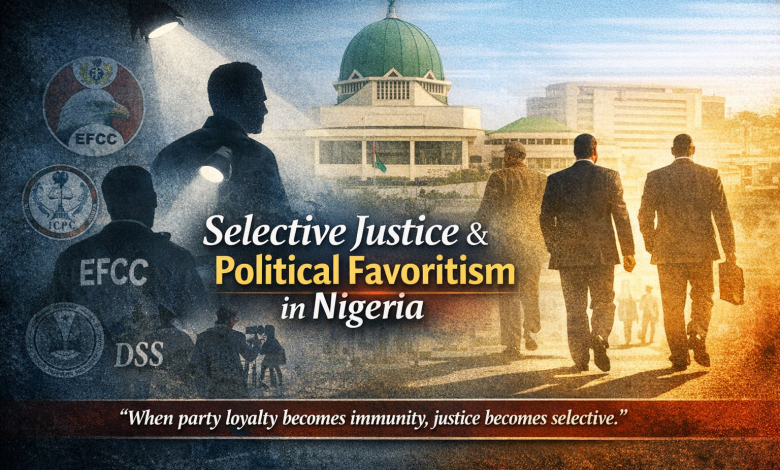
However, the recent pattern of repeated summons and movements between the Economic and Financial Crimes Commission, the Department of State Services and the Independent Corrupt Practices Commission raises a deeper question:
Is justice in Nigeria applied equally—or selectively?
Across Nigeria’s political landscape, allegations of corruption and abuse of office are not uncommon. Yet, there is a growing perception that accountability is no longer determined solely by evidence, but by political alignment and proximity to power.
Those within the ruling structure appear insulated. Those outside it appear exposed.
This perception—whether fully accurate or not—is dangerous for democracy.
When citizens begin to believe that party affiliation determines legal outcomes, public trust in institutions erodes. Agencies that should embody justice risk being seen as instruments of political pressure.
Under both the All Progressives Congress and historically the People’s Democratic Party, similar patterns have emerged—where political power appears to influence the direction and intensity of accountability.
The Institutional Question
A healthy democracy depends on the consistency of its institutions. Where the rule of law is respected, investigations are guided strictly by evidence and due process—not political alignment.
Nigeria has, across different political eras, witnessed patterns where state institutions appear more active against perceived opponents than allies. This recurring cycle weakens public trust and undermines democratic growth.
Justice loses its meaning the moment it becomes conditional.
Why This Matters
Selective justice affects far more than politicians. It directly impacts:
Public confidence in governance
Investor trust in Nigeria’s system
Youth participation in politics
Nigeria’s democratic reputation globally
When the rule of law weakens at the top, its effects cascade through every layer of society.
The Way Forward
Nigeria must recommit to three foundational principles:
1. Institutional Independence
Agencies like the EFCC, DSS, and ICPC must operate free from political direction.
2. Equal Application of the Law
No individual—regardless of party or position—should be above the law.
3. Transparent Due Process
Investigations must be fair, open, and evidence-based—not selective or strategic.
A Defining Choice
Nigeria now faces a defining choice:
A system governed by law and fairness
or
A system shaped by political convenience and protection
If justice becomes negotiable, democracy becomes fragile.
But if justice remains impartial, Nigeria can still build a system worthy of the hopes of its people.
The time to choose is now.
Author Profile
Abdulwahab Muhammad
Senior Special Assistant on Communication to the Executive Governor of Bauchi State.
Public affairs communicator, policy advocate, and media strategist.
About AlphaPressMedia
AlphaPressMedia is a digital public affairs and development-focused media platform committed to credible journalism, governance reporting, and citizen engagement across Nigeria and beyond.
EDITORIAL NOTE
This article is part of AlphaPressMedia’s Democracy & Governance Series, aimed at promoting accountability, transparency, and institutional integrity in Nigeria.