By Abdulwahab Muhammad SSA Communication to governor Bala Abdulkadir Muhammed.
Overview
Nigeria’s democratic journey has often been shaped by the tension between strong executive authority and the need for independent institutions.
Across different administrations, observers have raised concerns about how government apparatus can be deployed to consolidate power, sometimes at the expense of political opponents, legislative independence, and judicial neutrality.
Executive Influence on Political OpponentsAnalysts note that ruling governments in Nigeria have historically wielded state institutions — security agencies, regulatory bodies, and administrative machinery — in ways that critics argue can intimidate or weaken opposition voices.
This pattern reflects a broader challenge in ensuring that political competition remains fair and free from undue pressure. Executive dominance often manifests in surveillance, selective enforcement of laws, or restrictions on opposition activities.
Such practices raise questions about the balance between maintaining order and safeguarding democratic freedoms.
Legislative Co-optation:Nigeria’s legislature is constitutionally designed to act as a check on executive power. Yet, observers frequently highlight how ruling parties seek to “pocket” lawmakers through patronage, incentives, or political pressure. Legislative independence is undermined when lawmakers align too closely with the executive, reducing oversight.
This dynamic can lead to rubber-stamp legislatures that prioritize party loyalty over accountability.The judiciary is meant to be the guardian of constitutional order.
However, critics argue that political influence sometimes seeps into court proceedings, shaping outcomes in ways that favor incumbents.
Judicial neutrality is compromised when appointments, case assignments, or rulings appear politically motivated. This erodes public trust in the courts and weakens the rule of law.
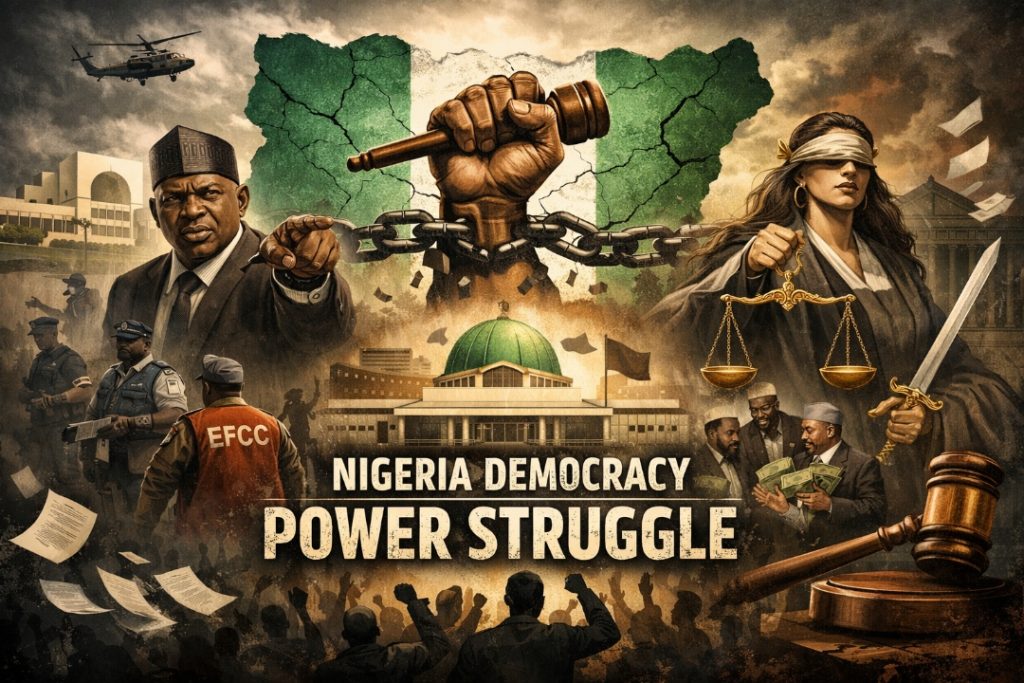
The interplay of executive dominance, legislative co-optation, and judicial manipulation highlights the fragility of Nigeria’s democratic institutions.
For democracy to thrive, checks and balances must be strengthened, and institutions must operate independently of partisan interests. –
Checks and balances remain the cornerstone of preventing overreach. – Civil society, media, and grassroots movements play a vital role in demanding accountability.
Conclusion.
Nigeria’s democratic system continues to evolve, but the recurring themes of executive influence, legislative alignment, and judicial compromise underscore the importance of institutional independence.
By addressing these systemic challenges, the country can move closer to realizing a democracy that is both resilient and inclusive.
End