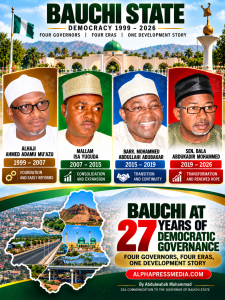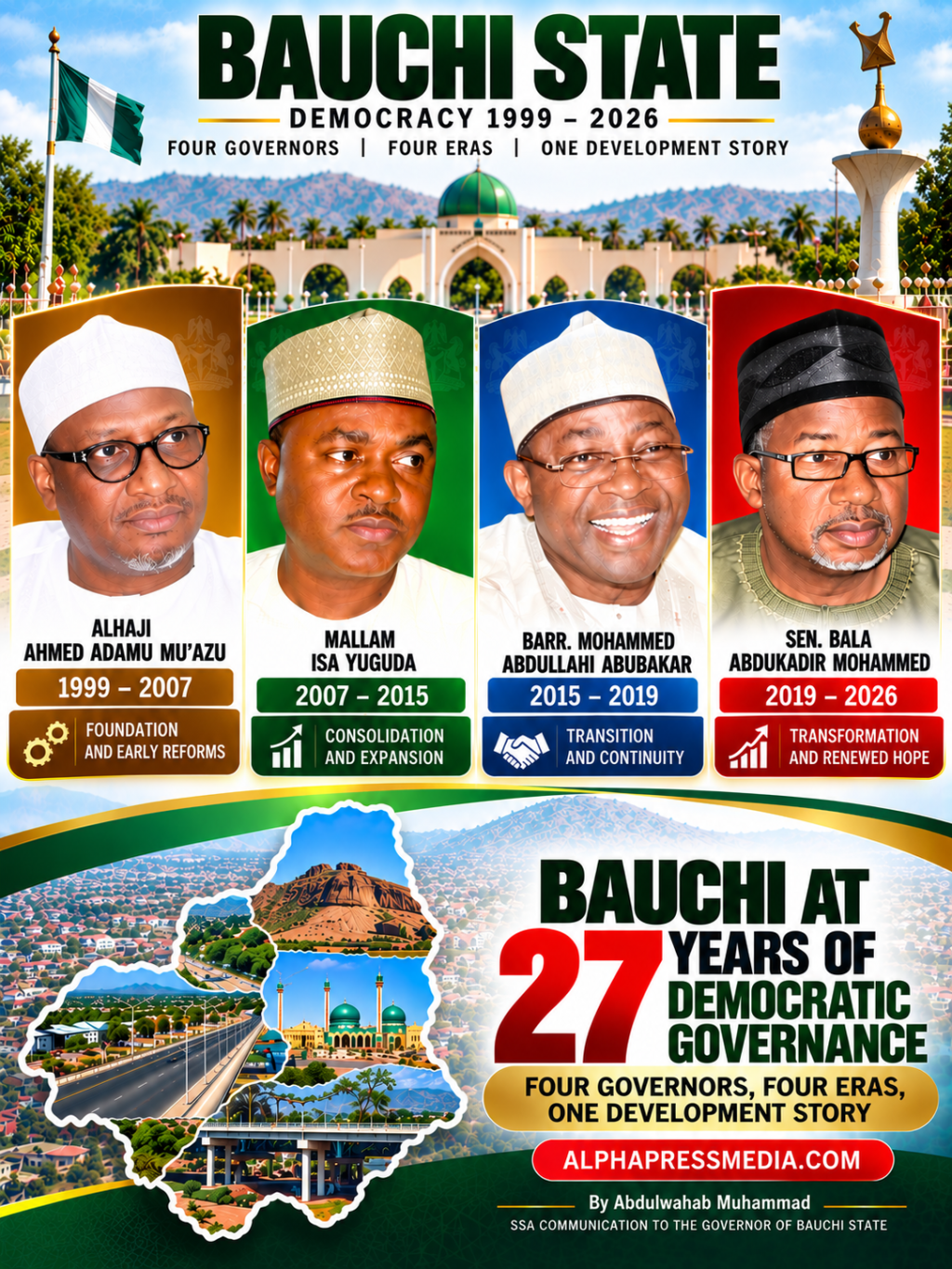
From Mu’azu’s rural electrification and road revolution to Yuguda’s establishment of Bauchi State University, Abubakar’s infrastructure and social-service interventions, and Bala Mohammed’s urban renewal and rural development programmes.
By Abdulwahab Muhammad, SSA Communication to the Governor of Bauchi State
Published by Alphapressmedia.com
27 YEARS, FOUR GOVERNORS, ONE TRANSFORMATION: HOW BALA MOHAMMED REDEFINED BAUCHI’S DEVELOPMENT STORY
From Mu’azu’s post-military foundations to Yuguda’s ambitious projects, Abubakar’s four-year administration and Bala Mohammed’s infrastructure-driven reforms, Bauchi State’s democratic journey offers a compelling story of leadership, development, achievements and unfinished business.
By Abdulwahab Muhammad, SSA Communication to the Governor of Bauchi State
Published by Alphapressmedia.com
Bauchi State has witnessed four civilian administrations since Nigeria returned to democratic governance in 1999. Each governor inherited a different set of challenges, pursued distinct priorities and left behind achievements that continue to shape the state’s political, economic and social landscape.
Yet, as the state approaches another political transition in 2027, one question has become increasingly prominent in discussions about its development: Which administration has made the most visible and lasting contribution to Bauchi’s transformation?
For supporters of Governor Bala Abdulkadir Mohammed, the answer lies in the extensive road construction, urban renewal, housing development, rural connectivity and public-sector interventions undertaken since he assumed office on May 29, 2019.
But a meaningful assessment requires more than political applause. It demands a careful examination of the records of former Governors Ahmed Adamu Mu’azu, Isa Yuguda and Mohammed Abdullahi Abubakar, alongside the achievements and remaining challenges of the incumbent administration.
The central argument emerging from this comparison is that Bala Mohammed has pursued one of the most ambitious infrastructure-led development programmes in Bauchi’s recent history, with projects that have significantly altered the physical appearance of the state capital and improved access to several communities.
Whether that translates into overall superiority across every governance indicator requires a broader examination of financial performance, service delivery, project sustainability and measurable improvements in citizens’ living standards.
MU’AZU (1999–2007): LAYING THE FOUNDATIONS OF DEMOCRATIC GOVERNANCE
When Alhaji Ahmed Adamu Mu’azu assumed office in 1999, Bauchi State was emerging from years of military administration.
His government faced the responsibility of restoring public confidence in democratic institutions, strengthening administrative structures and responding to growing demands for infrastructure and social services.
Mu’azu’s eight-year administration contributed to the state’s post-military institutional development. His tenure must therefore be assessed against the economic conditions, federal allocations and administrative challenges of that period.
However, many of the infrastructure challenges confronting Bauchi today, including deteriorating roads, inadequate drainage and expanding urban settlements, demonstrate the limitations of earlier development efforts.
The question is not whether Mu’azu contributed to Bauchi’s development, but whether the infrastructure created during his administration was sufficient to accommodate the state’s growing population and economic needs.
His legacy remains part of Bauchi’s democratic foundation, even as subsequent administrations have sought to expand and modernise that foundation.
ISA YUGUDA (2007–2015): AMBITIOUS PROJECTS AND THE QUESTION OF SUSTAINABILITY
The administration of Mallam Isa Yuguda introduced a different development approach, characterised by major public projects and efforts to strengthen Bauchi’s position as an emerging commercial and administrative centre.
Among the notable developments associated with his administration was the Bauchi State International Airport, established in 2014.
The airport remains an important transportation asset, demonstrating that projects undertaken by previous administrations can continue to serve the state long after their initiators leave office.
Nevertheless, the Yuguda administration attracted criticism over public expenditure, project sustainability and the management of state resources.
The long-term economic benefits of major capital projects must be measured against their construction costs, maintenance requirements and contribution to economic productivity.
An airport, water scheme or housing estate cannot be judged solely by the amount spent on its construction. Its actual value depends on how effectively it serves residents and supports economic activity.
Yuguda’s legacy consequently presents a combination of ambitious development initiatives and continuing questions about fiscal sustainability.
MOHAMMED ABDULLAHI ABUBAKAR (2015–2019): GOVERNANCE UNDER ECONOMIC PRESSURE
Barrister Mohammed Abdullahi Abubakar governed Bauchi State during a difficult period in Nigeria’s economic history.
His administration coincided with the economic recession of 2016, when declining national revenues placed considerable pressure on state governments.
Public expectations remained high, while the resources available to meet them were constrained.
The administration faced criticism over infrastructure delivery, workers’ welfare and the pace of economic development.
For many residents, the condition of roads, public facilities and essential services became important indicators of government performance.
However, describing the entire four-year administration as a period without any achievement would require comprehensive project and financial records to substantiate.
A fair assessment must distinguish between projects initiated, projects completed, programmes maintained and promises that remained unfulfilled.
Abubakar’s tenure also illustrates the difficulties of managing public expectations during periods of economic uncertainty.
The ultimate measure of his administration is not simply the number of projects announced but the lasting benefits delivered to Bauchi residents.
BALA MOHAMMED (2019–2026): AN INFRASTRUCTURE-DRIVEN TRANSFORMATION
When Senator Bala Abdulkadir Mohammed assumed office in May 2019, his administration placed infrastructure development, urban renewal, rural connectivity and public-service improvements at the centre of its agenda.
Seven years later, the scale and geographical spread of the government’s infrastructure programme have become defining features of his leadership.
Unlike development approaches concentrated exclusively on the state capital, the Bala Mohammed administration has pursued projects across urban and rural communities.
The administration’s development priorities encompass roads, water, sanitation, housing, healthcare, education, social welfare, public finance and economic revitalisation.
URBAN RENEWAL: CHANGING THE FACE OF BAUCHI
One of the most visible aspects of Governor Bala Mohammed’s administration has been the transformation of important road corridors and urban infrastructure.
Road construction, rehabilitation, dualisation and associated drainage improvements have featured prominently in the government’s development agenda.
These interventions are particularly significant in Bauchi metropolis, where population growth, commercial expansion and increasing vehicle ownership have created demand for improved transportation networks.
The administration has also pursued major road improvements serving residential neighbourhoods, commercial districts and public institutions.
For residents, improved roads offer practical benefits beyond physical appearance. They can reduce transportation difficulties, improve access to public services and encourage private investment.
Urban renewal is therefore not merely an exercise in beautification. Properly executed, it provides the physical infrastructure necessary for economic growth.
The 2025 Bauchi State budget performance records include allocations for urban road dualisation and rehabilitation, illustrating the continuing priority given to transportation infrastructure.
RURAL CONNECTIVITY: TAKING DEVELOPMENT BEYOND THE STATE CAPITAL
Perhaps one of the most consequential dimensions of the Bala Mohammed administration is its attention to rural road development.
Bauchi is a predominantly agricultural state, with thousands of farming households depending on road networks to transport produce, access markets and obtain essential services.
For these communities, a functional road can determine whether agricultural produce reaches the market profitably or deteriorates before sale.
In August 2024, the government announced the commencement of 115 kilometres of rural road projects across the state’s three senatorial zones under the Rural Access and Agricultural Marketing Project.
The projects included the Charachara–Ragwam–Magwanshi–Lafiya, Mainamaji–Badara–Kuka–Pali, Akuyam–Gwaram–Hardawa, Durum–Nahuta and Garin Gami–Gadai–Madufa corridors.
The state government disclosed that the contracts were valued at more than ₦23 billion, with ₦2.4 billion provided as counterpart funding. These were announced construction commitments, rather than proof that every kilometre had been completed.
Similarly, the administration announced a 38-kilometre rural road project in Kirfi Local Government Area, valued at approximately ₦18 billion, as part of efforts to improve connectivity and economic opportunities.
The importance of such investments extends beyond transportation. Improved rural access can strengthen agricultural value chains, encourage commercial activity and reduce the isolation of underserved communities.
This approach provides a significant basis for assessing Bala Mohammed’s development strategy against those of his predecessors.
HOUSING, HEALTHCARE AND HUMAN CAPITAL DEVELOPMENT
Infrastructure development is incomplete without corresponding improvements in housing, healthcare, education and citizens’ welfare.
The Bala Mohammed administration has identified housing and urban development as important components of its wider transformation programme.
Its housing initiatives have been presented as efforts to address accommodation shortages, improve planned settlements and expand access to residential infrastructure.
Nevertheless, the success of any mass housing programme must be evaluated through the number of completed and occupied units, affordability, access to utilities and the quality of construction.
Healthcare and education are equally important.
The government’s development priorities include improving healthcare facilities, strengthening social services and expanding educational opportunities.
While buildings and equipment are visible indicators of investment, their long-term value depends on the availability of qualified personnel, adequate operating budgets and consistent service delivery.
The most meaningful achievement of any administration is not simply the number of facilities constructed, but the extent to which those facilities improve people’s lives.
REVENUE GENERATION AND FINANCIAL MANAGEMENT: WHAT THE RECORDS REVEAL
The financial performance of Bauchi State provides another important basis for comparing successive administrations.
Like many Nigerian states, Bauchi has historically depended heavily on allocations from the Federation Account.
Increasing internally generated revenue is therefore essential for improving fiscal flexibility and reducing dependence on federal transfers.
Available independent data show that Bauchi recorded substantial growth in internally generated revenue over the decade from 2015 to 2024.
BudgIT’s 2025 State of States report indicates that Bauchi’s internally generated revenue grew by approximately 501% between 2015 and 2024, while growth between 2020 and 2024 stood at approximately 159%.
However, the report also reveals that total debt increased substantially over the same periods. This means the state’s revenue achievements must be considered alongside its borrowing obligations and expenditure commitments.
The Bauchi State Government’s 2025 Citizens’ Budget projected internally generated revenue of approximately ₦33.99 billion, alongside substantial federal transfers and other financing sources.
These figures support the argument that the state has expanded its revenue capacity, but they do not establish that borrowing has been eliminated or that fiscal challenges have disappeared.
The administration has also reported the issuance of a ₦41 billion private bond to finance infrastructure projects.
The essential question is whether the economic and social returns from these investments will justify their financing costs over time.
A responsible assessment of the Bala Mohammed administration must acknowledge both its revenue mobilisation efforts and the continuing importance of prudent debt management.
WORKERS’ WELFARE: ADDRESSING THE BURDEN OF UNPAID GRATUITIES
Another important aspect of the current administration’s record is its intervention in the payment of outstanding gratuities owed to retired public servants.
For many pensioners, delayed retirement benefits represent years of financial hardship following decades of public service.
In 2026, the Bauchi State Government announced the release of ₦10 billion for the verification and payment of outstanding gratuities.
The payment programme began with earlier outstanding batches and was subsequently extended to additional retirement years.
The intervention represents an important effort to address a longstanding welfare problem.
However, the ultimate success of the exercise will depend on the proportion of verified liabilities settled, the number of beneficiaries paid and the establishment of a sustainable system that prevents future arrears.
Workers’ welfare must remain a continuous responsibility rather than an occasional intervention.
LEADERSHIP, POLITICAL INCLUSION AND ADMINISTRATIVE DIRECTION
Beyond physical development, the leadership styles of the four governors offer another dimension for comparison.
Mu’azu governed during a period of democratic consolidation.
Yuguda pursued ambitious development initiatives while navigating significant political realignments.
Abubakar operated under difficult economic circumstances and faced the challenge of maintaining public confidence during a period of constrained resources.
Bala Mohammed, meanwhile, has built a political identity around infrastructure delivery, grassroots engagement and a broad public development agenda.
His experience as a former senator and Minister of the Federal Capital Territory provided a background in national governance before his election as governor.
His supporters frequently cite his accessibility, political experience and engagement with traditional institutions, community leaders and professional groups as distinguishing qualities.
Such assessments, however, are partly subjective. Leadership quality must ultimately be judged through institutional performance, transparency, responsiveness and the extent to which citizens benefit from government policies.
THE COMPARATIVE SCORECARD: FOUR ADMINISTRATIONS, DIFFERENT DEVELOPMENT PRIORITIES
Ahmed Adamu Mu’azu (1999–2007)
Defining focus: Post-military democratic consolidation and institutional development.
Key issue for assessment: Sustainability and reach of public investments.
Isa Yuguda (2007–2015)
Defining focus: Major capital projects and transportation infrastructure.
Key issue for assessment: Fiscal costs and long-term project value.
Mohammed Abdullahi Abubakar (2015–2019)
Defining focus: Governance during national economic difficulties.
Key issue for assessment: Service delivery, infrastructure and workers’ welfare.
Bala Abdulkadir Mohammed (2019–2026)
Defining focus: Urban renewal, rural roads and infrastructure-led development.
Key issue for assessment: Completion, affordability, debt sustainability and measurable social impact.
This comparison demonstrates how the priorities and circumstances of successive governments have differed. It does not, by itself, constitute a numerical ranking of their overall performance.
WHY BALA MOHAMMED’S DEVELOPMENT RECORD STANDS OUT
Several characteristics distinguish the current administration’s approach.
First is the emphasis on visible infrastructure projects designed to improve urban mobility and connect rural communities.
Second is the geographical ambition of its development programme, extending investment beyond the capital to agricultural and economically important areas.
Third is the administration’s continued attention to public infrastructure as a foundation for investment, commerce and improved access to essential services.
Fourth is its effort to address inherited welfare obligations, particularly outstanding gratuities.
These interventions provide substantial grounds for arguing that Bala Mohammed has established a distinctive development legacy.
Nevertheless, the full impact of his administration cannot be measured exclusively by construction activity.
The durability of roads, efficiency of public spending, affordability of housing, quality of healthcare, educational outcomes, poverty reduction and long-term fiscal stability will ultimately determine the strength of that legacy.
THE UNFINISHED BUSINESS OF TRANSFORMATION
Despite the administration’s infrastructure achievements, Bauchi continues to face development challenges.
Rural poverty, unemployment, insecurity in some communities, pressure on healthcare and educational facilities, and the need for stronger private-sector participation remain important concerns.
Improved roads must translate into more productive businesses.
Agricultural investment must translate into higher incomes for farmers.
Public revenue growth must support better services without imposing unsustainable burdens on households and businesses.
And new infrastructure must be adequately maintained to protect public investment.
These challenges do not diminish the importance of projects already delivered. Rather, they establish the standards against which the administration’s long-term success should be measured.
CONCLUSION: FROM POLITICAL PROMISES TO A LASTING DEVELOPMENT LEGACY
Twenty-seven years after Nigeria’s return to democratic governance, Bauchi State’s development story remains a continuing journey shaped by four different administrations.
Mu’azu helped steer the state through the early years of democratic restoration.
Yuguda pursued major public projects and expanded important elements of the state’s infrastructure.
Abubakar governed during a challenging national economic period.
Bala Mohammed has placed infrastructure expansion and urban renewal at the centre of a far-reaching development programme.
Of the four administrations, the current government has made a particularly visible mark on Bauchi’s physical landscape, supported by documented road projects, rural connectivity initiatives and continuing public investment.
For its supporters, these achievements establish Bala Mohammed as a transformative figure whose administration has surpassed those of his predecessors in the scale and visibility of development.
The strongest argument for Bala Mohammed’s legacy is therefore not that every predecessor failed, but that his administration has built upon Bauchi’s accumulated foundations while pursuing a development agenda of considerable scale and ambition.
As his tenure approaches its conclusion in 2027, the lasting question will be whether these investments continue to improve the lives of Bauchi residents long after the political celebrations have ended.
For Governor Bala Abdulkadir Mohammed, the roads, public facilities and development programmes of today are already shaping the historical assessment of tomorrow.
And for Bauchi State, the ultimate measure of progress remains clear: not merely how much has been built, but how profoundly development has improved the lives of the people.
By Abdulwahab Muhammad
Senior Special Assistant on Communication to the Governor of Bauchi State
Published by Alphapressmedia.com